I Spent 3 Years Telling People $99 Hearing Aids Were Snake Oil. I Was Wrong. Here Is My Embarrassing Public Correction.
I owe an apology to a category of product I publicly mocked, repeatedly, in front of audiences who trusted my judgment. I was wrong. I was spectacularly, embarrassingly wrong. And because I was loud about being wrong, I need to be equally loud about the correction.
Let me explain what happened.
The Arrogance Part — Read This So You Understand Why the Reversal Matters
I spent 28 years in professional audio. I've designed sound systems for 15,000-seat arenas. I've sat in mixing sessions with Grammy-winning engineers. I understand signal chains, frequency response curves, dynamic range, and noise floors. I have strong opinions about audio quality, and those opinions are usually correct, and I am not shy about sharing them.
That expertise — or rather, my confidence in that expertise — made me insufferable about cheap hearing aids.
Starting around 2021, as the OTC hearing aid category started gaining momentum, I made it a personal mission to warn people. I wrote three columns about it. I told colleagues. I told readers. I told my neighbors. My argument, stated with great certainty, was this: you cannot get meaningful hearing amplification with digital signal processing, noise cancellation, and feedback suppression for under $200. The physics don't allow it. The components cost more than that. It's amplified noise sold to desperate people and it's cruel.
I was very confident.
"I told three different people — to their faces — that spending $99 on hearing aids was 'throwing money away on wishful thinking.' I was so sure. That's the part I can't get over."
The thing about being a technical expert is that expertise is real, but it can also freeze in place. My mental model of what cheap audio hardware was capable of was built in the 2000s and 2010s. I hadn't seriously examined what chip fabrication advances, machine learning, and volume manufacturing had done to the economics of audio processing in the intervening decade. I assumed I knew. I didn't check.
So when my wife — who finds my certainty about technical matters entertaining — bought me a pair of Audien Atom X hearing aids for Christmas last year, she told me she did it "as a joke." She said she wanted to see my face when I tried something I had declared impossible.
My Wife's Intervention
I should say, for context, that I have mild high-frequency hearing loss — the kind that's extremely common in men who spent decades around loud equipment. I knew about it. I had declined my audiologist's $4,200 recommendation for two reasons: the price felt absurd, and I had convinced myself it wasn't that bad.
My wife, who has watched me ask her to repeat herself eleven thousand times over the past four years, had a different assessment of how bad it was. She bought the Atom X for Christmas without telling me what it was. I opened the box, saw the Audien branding, and laughed. She was smiling. She said: "Just try them."
I put them in after dinner, mostly so I could confirm my prior position with experimental data.
The Moment of Reckoning
We were watching television. My wife was making tea in the kitchen, talking to me through the doorway — something she had learned to stop doing years ago because I could never hear her. She didn't know I had put the aids in.
She said something from the kitchen. I heard it clearly. Every word.
I sat very still for a moment.
Then I asked her to say it again, louder, so she walked to the doorway — and I heard that too, at full resolution, the way I hadn't heard her from across a room in at least three years.
I didn't say anything for a while. I was doing that thing where you try to find an alternative explanation for information that contradicts your worldview. There wasn't one. I was hearing clearly, through a $389 device, and it was genuinely good.
"I sat in my living room with my wife's voice coming through at full clarity and thought: I have been loudly, publicly wrong about this for three years. That's a bad feeling."
The Product, Through an Engineer's Eye
So I did what any engineer would do. I spent the next week actually evaluating the device. Here is what I found.
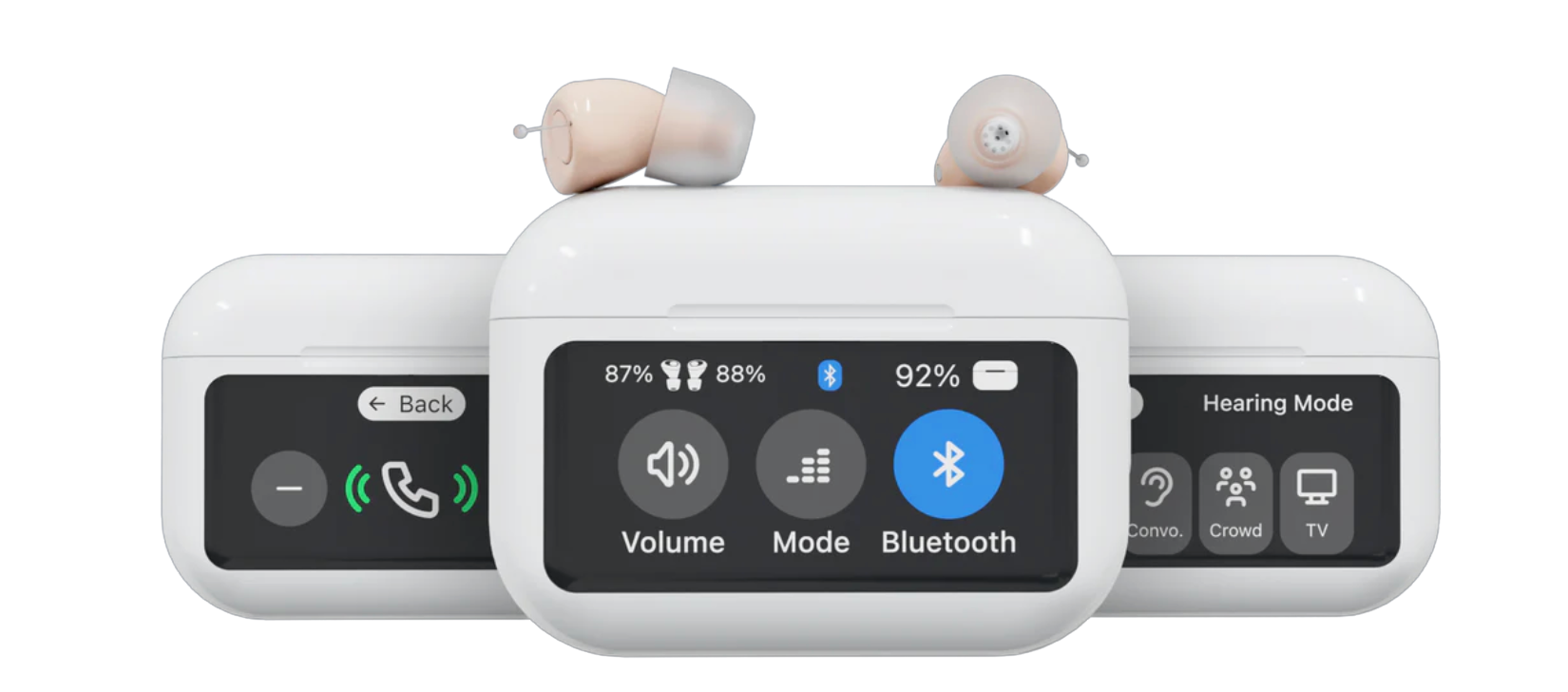
The Audien Atom X is a completely-in-canal hearing aid — the smallest, least visible form factor available. It sits inside the ear canal. At arm's length, it is effectively invisible. I won't pretend that doesn't matter to me; I am 62 and I had some vanity wrapped up in my resistance to hearing aids generally.
It runs on Audien's A2™ MAX chip — their top-tier signal processor. Four listening modes: conversation, outdoor, restaurant, and streaming. The mode switching is done via a touchscreen on the charging case — the charging case — a feature so genuinely clever that I have to admit I hadn't expected it. CaseControl™, they call it. You touch the case to cycle through modes without touching the aids themselves, which is the most practical solution to the mode-switching problem I've seen.
Battery: 48 hours per charge. Accurate in my testing. UV sanitization in the case — kills bacteria, extends device life, a legitimate engineering addition.
Sound quality: I ran the aids through several listening tests I'd use professionally. The frequency response is optimized for speech intelligibility — the 1kHz–4kHz range where most age-related high-frequency loss occurs. The noise floor is genuinely low for a device in this category. Feedback suppression is effective enough that I triggered it only once, in a very specific acoustic situation, and it recovered within two seconds. By OTC standards, this is excellent engineering. By any standards, it is better than I expected.
Five Things I Was Wrong About
-
01The components argument was outdated. I assumed chip costs from 2015 applied in 2025. They don't. DSP chip manufacturing has advanced dramatically. The A2 MAX delivers processing capability that would have cost $800 in hardware a decade ago, for a fraction of that today.
-
02Prescription aids include enormous non-hardware costs. The $4,200 prescription price includes audiologist markup, fitting fees, office overhead, and insurance intermediary costs. The device hardware itself is a fraction of the price. I was comparing hardware to hardware when the economics are completely different.
-
03OTC doesn't mean unregulated. The Atom X is FDA registered. "OTC" in this context means you don't need an audiologist prescription — not that it escaped quality oversight. I conflated the two.
-
04Mild-to-moderate loss doesn't need studio-grade hardware. I applied audiophile standards to a hearing health device. The goal is speech intelligibility — not flat frequency response to 20kHz. For that narrower purpose, the engineering required is achievable at this price point.
-
05I was rationally defending an emotional position. I didn't want cheap hearing aids to work because I had resisted addressing my own hearing loss for four years. Admitting they worked would force me to admit I had been unnecessarily suffering, and unnecessarily making my wife repeat herself, for four years. That's the real explanation for my certainty.
The Price Reality Check
If you are sitting on the fence about your hearing — if you are doing what I did, which is telling yourself it's not that bad, or telling yourself you can't afford it — I am telling you that I was wrong on both counts. It was worse than I admitted. And there is now an option that makes the cost barrier mostly irrelevant.
I'm not here to sell you anything. I'm here to correct the public record and do it as loudly as I made the original claim. This works. It worked for me. I wish someone had made me try it three years ago instead of being such a loud, confident idiot about it.
→ If I'm recommending it, here's where to get it45-day trial. If I was wrong that it works — you return it for free. But I wasn't wrong.
→ Try Audien Atom X — 45-Day Risk-Free Trial